
One island.
A world of coastlines.
Some of Sardinia’s greatest beaches ask you to work for them. Others make doing very little feel like the best decision you’ve made all year. The pleasure is finding your kind of coast.
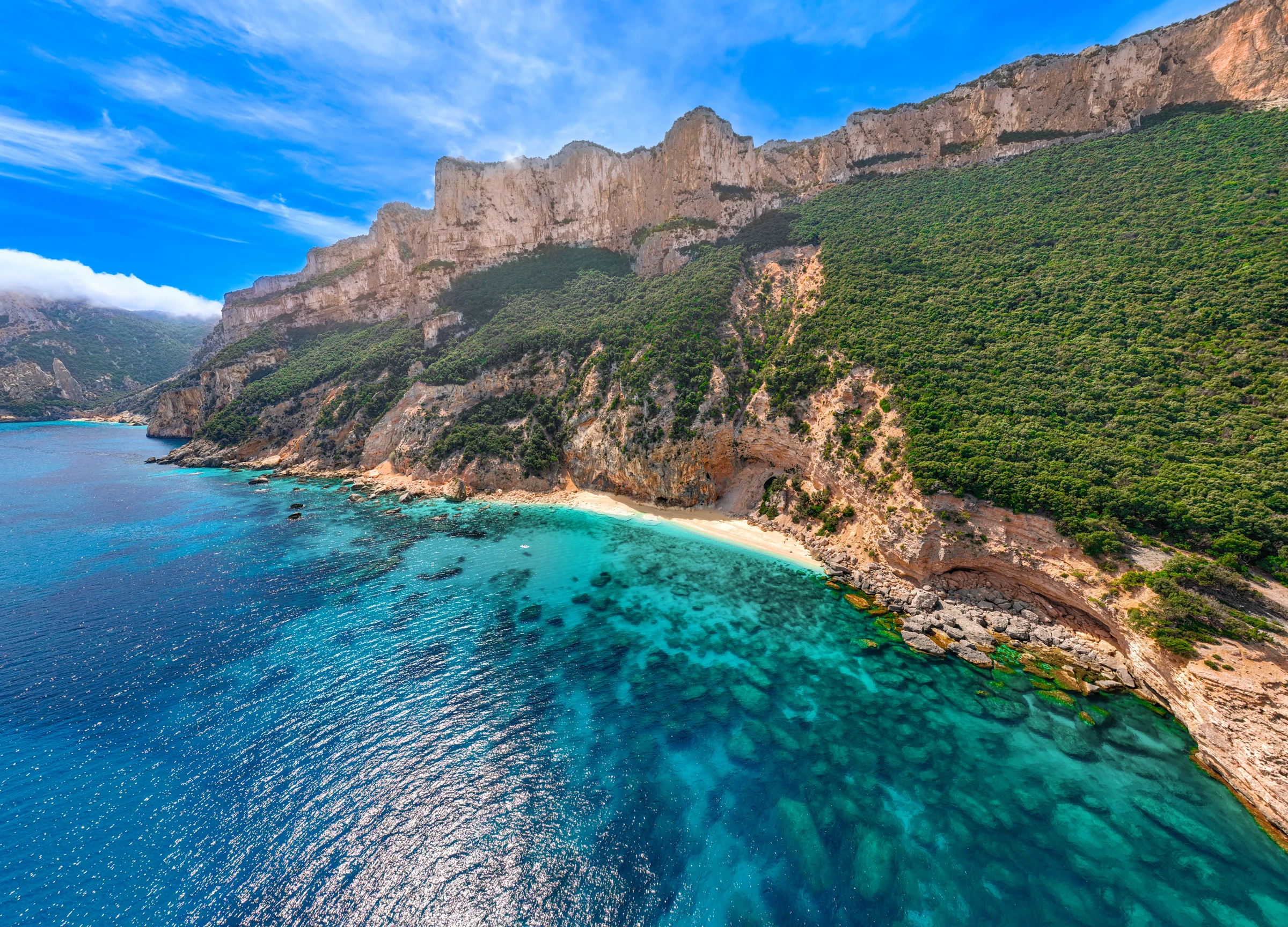 SARDINIA · A CLOSER LOOKCALA DEI GABBIANI
It is easy to fall for a photograph of Sardinia. Deciding where to spend a week takes a little more thought.
That extraordinary cove might sit at the bottom of a mountain trail. Those islands scattered across the horizon might become the whole purpose of your holiday. Or perhaps the real temptation is a house near a long sandy beach, with no particular reason to get in the car tomorrow. All three holidays are possible here. They simply belong to different stretches of coast.
The best place to stay is the one that makes you excited about the days themselves. Here are nine very different ways to spend them.
Cliffs, coves and a sense of scale.
The thrill of Baunei begins before you ever set foot on a beach. Along this fiercely rugged coast, enormous limestone cliffs crowd the sea, leaving little pockets of brilliant white shore in places that look almost impossible to reach. Exploring them means heading out by boat or following trails through the mountains, rather than driving from one beach car park to the next. For anyone who loves the thought of rounding a headland and finding something astonishing beneath the cliffs, this is a coast to get genuinely excited about.
Choose Baunei for the adventure as much as the beaches. Boats make many of its famous coves accessible without a strenuous walk, but Cala Goloritzé is the important exception: boats cannot land on the beach, and the walking trail descends roughly 500 metres before asking you to climb back out again. That return deserves respect, particularly in the heat. There are easier choices in Sardinia for effortless trips between hotel and sand. Here, reaching the shore is a substantial—and potentially wonderful—part of the day.
And what a shore to arrive at. Cala Goloritzé was named the best beach on Earth in our 2025 list and now belongs to our Best of the Best collection. Beneath its soaring limestone pinnacle, with a natural arch reaching into the water, the setting has an almost mystical grandeur. This is the reward for choosing Baunei: the chance to swim somewhere so extraordinary that even the prospect of the climb home can briefly lose its importance.
Perhaps the most startling detail is that the beach itself is younger than many of its admirers. The local tourism office records shepherds’ accounts of it beginning to form after a landslide in the 1950s. What looks like an eternal meeting of mountains and sea is still changing. It is a fascinating thought to carry down the trail: this landscape is still being made.
Goloritzé could easily dominate the trip, were Cala Mariolu not nearby. Another of our Best of the Best beaches, Mariolu has tiny white pebbles that inspired local shepherds to give it a name meaning “snow fleas”. Cala Birìala, Cala dei Gabbiani, Cala Sisine and Cala Luna provide further reasons to explore. Give the coastline several days, and there is room for both kinds of experience: the ambitious walk you will remember for years, and the boat journey that keeps revealing another beautiful place to swim.
An island beyond every headland.
Some people see an island on the horizon and immediately want to know what is on the other side. La Maddalena is made for that curiosity. Here, Sardinia breaks into a scatter of granite islands, with sandy coves hidden between rounded headlands and stretches of astonishingly bright water separating one discovery from the next. Boats belong in the picture—not merely as transport to a beach, but as one of the great pleasures of being here.
The surprise is that you do not need one every morning. After the ferry crossing from Palau, a stay on La Maddalena itself gives you beaches such as Bassa Trinità, while a bridge and causeway lead to neighbouring Caprera. You can alternate days exploring on land with days among the smaller islands, then return to La Maddalena town for dinner. This is an island holiday with a proper town at its heart, rather than a remote resort where the evening ends when the excursion does.
Out on Spargi, Cala Corsara and Cala Granara deliver the archipelago’s great promise: pale sand tucked between sculpted granite, with water that makes it difficult to concentrate on anything else. The many inlets also explain why a good boat day should respond to conditions rather than follow a rigid checklist. Shelter varies around the islands; the most rewarding stop is not necessarily the most famous name on the itinerary.
Caprera’s Cala Coticcio offers its own thrilling arrival, but it is not a casual roadside beach. The hiking approach is managed and requires an authorised guide. That distinction matters when choosing this region: there are easy outings, boat excursions and more deliberate adventures, all within the same holiday. You can decide how much effort belongs in each day.
Then there is Budelli’s Spiaggia Rosa. Its delicate pink colour owes much to the remains of tiny marine organisms associated with underwater seagrass. Knowing that living things helped create the colour makes it more remarkable, not less. The beach is protected from walking and swimming, so this particular wonder must be admired without settling onto it. Come to La Maddalena with that spirit of discovery: not every beautiful place needs to become a place where you put down your towel.
Where the beach is only the beginning.
A morning in a beautiful cove, a long lunch, and somewhere worth dressing up for that evening: Costa Smeralda makes a seductive case for having it all. The coastline is intimate—rocky headlands, sandy inlets, vegetation crowding close to the shore—while the holiday around it can be wonderfully indulgent. Elegant hotels, villas and the waterfront life of Porto Cervo are part of the attraction. This is not the corner of Sardinia to choose because you want to escape every trace of the outside world.
But do not let the yachts distract you from why people came. Capriccioli is a particularly lovely introduction, its granite dividing the shore into four small beaches. Those divisions are useful as well as beautiful: the eastern coves have protection from the northwesterly mistral, while the western side offers shelter from easterly winds. A place that looks like one beach in a photograph contains several different possibilities for the day’s swim.
Spiaggia del Principe brings another exquisite inlet into the picture, while Liscia Ruja offers a broader sweep of sand when you want more room for a walk. The nearby bays of Grande Pevero and Piccolo Pevero add further reasons to explore. This is a coast for enjoying the small differences between beaches: the way a rock formation encloses the water, the view around a headland, the particular patch of sand you become reluctant to leave.
Even the buildings have a story worth knowing. Costa Smeralda’s modern development began in the 1960s with an architectural committee overseeing how the new destination would fit into the landscape. The village-like appearance was deliberate, drawing on local building traditions rather than simply importing a conventional resort skyline. Much of the apparent old-world charm is a carefully created modern vision.
That combination is what distinguishes a holiday here. You can be absorbed by a little granite cove in the afternoon and thoroughly enjoy the theatre of Porto Cervo that evening. There is no need to pretend that the hotel, dinner or atmosphere after dark is incidental. For some travelers, those are precisely what turn a collection of exceptional beaches into the right place to stay.
A holiday shaped by the shallows.
For anyone who wants to spend more of the holiday in the sea than getting to it, the coast around San Teodoro is deeply tempting. Fine sandy beaches, gently shelving water and pine-backed bays make swimming feel like the natural centre of the day. There is no need for a mountain expedition to reach the sort of water that first made you think about Sardinia. For families especially, that is an exciting prospect: an easier holiday without any sense of having settled for a lesser setting.
Cala Brandinchi and Lu Impostu are the obvious places to begin. A wooded headland separates the two bays, but both invite long spells in the shallows. Brandinchi’s nickname, “Little Tahiti”, is understandable, although with Tavolara rising across the water, the beach hardly needs to borrow another island’s identity. These are places where getting everyone out of the sea for lunch may prove harder than getting them there in the first place.
The choice is broader than those two celebrated beaches suggest. La Cinta runs for roughly three kilometres, with a lagoon behind the sand: a different proposition for anyone who likes to set off along the shore and keep walking. Around Capo Coda Cavallo, the coast becomes more intricate. Cala Suaraccia and the bays around the cape bring islands into the foreground, with Tavolara and Molara giving the views an unmistakable identity.
There is another distinction that beach photographs tend to miss. San Teodoro is not simply a sleepy family resort. In summer, its pedestrianised evening streets, markets, restaurants and nightlife give the holiday a sociable second half. That can be a considerable advantage for families with different ages to entertain, or couples who want beautiful swimming without retreating to their room after dinner. A stay around the cape puts more emphasis on the coastal setting; a base near town makes those evenings easier to enjoy.
Brandinchi and Lu Impostu require reservations during the regulated summer season, so a little forward planning belongs in the trip. Beyond that, the appeal is refreshingly straightforward: several lovely beaches, plenty of time in the water, and something to look forward to when the beach day is over.
Different beaches. One place to return to.
Villasimius is a place for the happily indecisive beach lover. A long sandy bay today, a smaller cove tomorrow, perhaps an afternoon spent with a mask on rather than lying on the shore. Around the granite headland of Capo Carbonara, the coastline keeps turning, opening into beaches of different shapes and sizes. The pleasure is having that choice without making a remote expedition the price of every beautiful swim.
The geography offers more than changing scenery. Beaches sit on both sides of the headland, so they do not all meet the wind in the same way. No cape can promise calm water every day, but different orientations give you options. That is a valuable advantage for a holiday built around swimming—and a good reason to take local advice about where to go that morning rather than deciding the entire week from photographs.
Porto Giunco supplies one of the area’s most memorable settings, with the sea in front and the Notteri lagoon behind. Flamingos may be feeding in the wetland while people swim on the other side of the sand: a rather wonderful reminder that a busy holiday coast can also be a living habitat. Cala Caterina, the dune-backed shore at Porto Sa Ruxi, and the long curve of Campulongu offer contrasting days nearby.
Some of the most important scenery is underwater. Meadows of Posidonia, a marine flowering plant rather than seaweed, provide habitat for sea life. Its fallen leaves also help protect the beaches: washed ashore in banks, they trap sand and soften the sea’s force. Those brown ribbons are not evidence that a beautiful beach has gone wrong. They are part of the natural system that helps keep it there.
For travelers who become snorkellers the moment the water looks interesting, that adds another reason to stay. Villasimius offers the immediate pleasure of a gorgeous beach, but rewards curiosity beyond it. Come for a holiday that leaves room to follow a rocky shoreline, notice what is moving beneath you, and choose tomorrow’s bay only when tomorrow arrives.
The pleasure of staying a little longer.
There is real luxury in being able to go for a swim without making an outing of it. Costa Rei is the part of Sardinia to investigate when that sounds more appealing than another ambitious itinerary. Its main shoreline stretches for roughly eight kilometres, with holiday houses and apartments spread behind the sand. Choose accommodation close to the beach, and the sea can become part of the day almost as casually as breakfast.
That changes the holiday. There is no pressure to stay out until everyone is exhausted because reaching the beach took so much effort. You can swim, go home for lunch and return later. Over a longer stay, those small freedoms become remarkably valuable. This is where we would look for the kind of family holiday that gradually develops its own habits.
Around Monte Nai and Piscina Rei, the long beach is the main event. Near Santa Giusta, the pale granite of Scoglio di Peppino gives the shoreline a distinctive landmark and a different setting for a swim. The region’s appeal is not that every few hundred metres reveals a completely new landscape. It is that there is enough beautiful shore to get properly attached to one part of it.
When curiosity returns, the neighbouring Castiadas coast provides a change of scene. Cala Sinzias adds another generous sandy bay, while Cala Pira feels more enclosed, framed by granite, dunes and old junipers. Look closely at the sand there and you may notice pinkish tones among the pale grains; look up and the coastal tower gives the bay its own recognisable silhouette. These are worthwhile outings, not obligations to keep you away from the beach you already love.
Costa Rei is particularly persuasive for a longer stay, or for anyone whose life at home contains quite enough scheduling. The question is not how many beaches you can visit. It is whether you might enjoy knowing one well enough to have a favourite time of day there.
Dunes, open water and unhurried days.
Chia is for the beach lover who wants room to wander. Here, the sand opens into broad bays, with dunes and old, wind-shaped junipers behind the shore. The beauty does not stop where the towels end. There is a whole coastal landscape to enjoy, and a feeling of openness quite different from being enclosed beneath the Baunei cliffs or between Costa Smeralda’s granite headlands.
It is also possible to enjoy that landscape without making the holiday particularly demanding. Established resorts sit near the bays, so a wild-looking backdrop need not mean sacrificing a comfortable room, a pool or an easy lunch. That is an important part of Chia’s appeal: you can want nature to dominate the view without wanting an expedition to dominate the day.
At Su Giudeu, the scene is especially inviting. A broad sandy beach faces a small rocky island, while a lagoon behind the shore attracts flamingos. The shallow seabed encourages lingering in the water, but this is also a place to leave the towel for a while and walk. There is pleasure in watching the offshore island shift against the coastline as you move, rather than experiencing the whole beach from one fixed spot.
Dune di Campana and Monte Cogoni continue the sequence of sandy bays. Farther along the coast, Tuerredda offers a more enclosed setting, its pale sand looking towards a little island within a deep inlet. The contrast is useful: Chia gives you the openness of a long beach without committing the entire holiday to one uninterrupted stretch of shore.
We would come here when the landscape itself is what we want to spend time with. A walk, a swim, something good for lunch, and no urgency to leave while the afternoon is still beautiful. The dunes and bays provide enough variety; the holiday does not need to manufacture more.
Every shade of blue.
You may arrive around Stintino with plans to explore and discover that all you really want to do is stay in the water. Towards Capo Falcone, the narrow peninsula separates two strikingly different coastlines: rugged cliffs facing the open sea on one side, and sheltered, sandy shallows looking towards islands on the other. For people who love wading and floating as much as swimming, this is a setting to take seriously.
La Pelosa is the irresistible centrepiece. Its pale seabed remains shallow well beyond the shoreline, producing that extraordinary expanse of blue, with the old tower and islands completing the view. The beauty is not something you appreciate only from a lookout. You can stand in the middle of it. Neighbouring La Pelosetta offers a smaller cove within the same remarkable setting.
This is not an undiscovered corner, and La Pelosa’s managed access deserves attention before you build a holiday around it. Its seasonal booking system is a reason to plan, rather than assume you can arrive whenever the mood takes you. Le Saline and Ezzi Mannu, with their pale, rounded grains and pebbles, broaden the choice along the coast. But it is the extensive shallows that make this area such a distinctive proposition.
Stintino itself gives the holiday a more human story. The village was founded in 1885 after families had to leave Asinara when a quarantine station and penal colony were established there. They built a new settlement across the water, retaining their connection to the island. The land visible offshore was not simply a beautiful backdrop; for those families, it was the home they had left.
Knowing that changes an evening walk around the harbour. The coastline becomes more than a famous photograph, even if the next morning brings you straight back to the same clear water. Choose Stintino because that repetition sounds delightful—not because you feel obliged to find a new beach every day.
A coastline worth a closer look.
On the Sinis Peninsula, the surprises begin on the way to the sea. The approach to Mari Ermi passes cultivated fields before arriving at a startling contrast: intensely blue water against a pale quartz shore. Around you are lagoons, farmland and an open coastline, rather than a holiday landscape organised entirely around hotels. This is an appealing choice for travelers who want their beach days to feel connected to the place beyond the beach.
And the shore itself deserves your attention. At Is Arutas, what looks from a distance like ordinary pale sand resolves into rounded quartz grains, some white, others pink or green, resembling tiny grains of rice. Mari Ermi and Maimoni share the peninsula’s distinctive quartz-rich beaches. Their beauty is unusually tactile: something you notice under your feet and examine close up, rather than simply admire across the water.
The marine park traces these grains to the erosion of ancient granite, remnants of which survive offshore at Mal di Ventre. That gives the beach a rather extraordinary history of its own. The little grains belong to a much larger, much older landscape, gradually broken down and reshaped. They are worth looking at carefully—and leaving exactly where you found them.
There is an important difference in the swimming, too. At Is Arutas, the seabed deepens relatively close to shore. For confident swimmers, getting into deeper water without a long wade can be part of the attraction. For a family whose main wish is prolonged play in ankle-deep water, the photographs alone could be misleading. This is not La Pelosa with different sand; it offers a genuinely different experience of the sea.
The wider peninsula makes that difference more rewarding. Around San Giovanni di Sinis, another sandy shoreline lies close to Tharros, where the remains of a city founded by the Phoenicians occupy a coastal setting of their own. A stay around Cabras can leave room for both the beaches and the history without treating one as a distraction from the other. Come to the Sinis because you enjoy that combination: a wonderful swim, something unexpected to discover, and the sense that the place has plenty to tell you once you start paying attention.
There is no obligation to turn these coastlines into a single itinerary. The boat journeys of La Maddalena and the easy beach routines of Costa Rei answer different wishes. So do the ambitious trails of Baunei and a long, comfortable afternoon around Chia.
Choose the place that makes you think, yes, that is how I want to spend my time. Then leave enough of the holiday unclaimed to enjoy it.
MORE STORIES